
Commercial HVAC Services in Grapevine, TX
Light-Commercial HVAC Diagnostics, Repair and Maintenance for Grapevine & the Mid-Cities
Commercial Equipment Fails for Measurable Reasons
Too Cool Air is a licensed commercial HVAC contractor based in Grapevine, Texas, serving light-commercial properties across the Mid-Cities. Sergio Villarreal, the owner, is a licensed HVAC contractor with more than 28 years of hands-on experience in North Texas, and commercial work is handled the same way residential work is: measure first, explain the readings, then repair what the readings show. Licensed TACLB50985E.
Commercial buildings punish equipment differently than houses do. Rooftop package units sit in full sun on a black membrane roof, run long hours through a Texas summer, and are expected to handle kitchen exhaust makeup air, door traffic, high internal loads from lighting and refrigeration, and filters that load up far faster than a home's. When a unit stops holding setpoint, the cause is usually airflow, a control sequence, or an electrical component — not simply "the unit is old."
Service is scheduled by appointment. Call (214) 437-7886 or book online and we will confirm the soonest available window for your property. Because the business is owner-operated, we tell you honestly when we can be there rather than promising coverage we cannot staff.
- Static pressure and airflow measured on each unit rather than estimated
- Refrigerant circuit verified by superheat and subcooling, not gauge pressure alone
- Electrical testing of compressors, contactors, capacitors and motors under load
- Control and thermostat sequence verified against how the equipment is actually staged
- Too Cool Air explains the measurements, findings and recommended options before work is approved
Commercial HVAC Diagnostics
A commercial diagnostic starts with the whole system, not the failed part. We record supply and return static pressure, measure airflow across the coil, take entering and leaving air temperatures, verify refrigerant charge by superheat and subcooling, test electrical components under load, and confirm the control sequence matches how the equipment is staged. That process separates a genuine component failure from a plugged filter bank, a slipping belt, a failed economizer damper, a shorted low-voltage circuit, or a thermostat calling for something the unit cannot deliver.
Every system is designed using:
- Total external static pressure on each air handler or rooftop unit
- Airflow and temperature split across the evaporator coil
- Superheat and subcooling on every refrigerant circuit
- Amp draw on compressors, condenser fans and blower motors
- Low-voltage control, staging and safety-circuit verification
This is why we diagnose first—not just swap parts and hope it fixes the problem.
A Grapevine-Based Commercial HVAC Contractor
Too Cool Air operates from 410 E Northwest Hwy #10 in Grapevine and serves commercial properties throughout Grapevine, Southlake, Colleyville, Coppell, Flower Mound, Keller, Trophy Club, Westlake, Roanoke, Las Colinas, Carrollton, Denton and the surrounding Mid-Cities. The work is owner-operated and licensed under TACLB50985E, which means the person diagnosing your equipment is the person accountable for the recommendation.
Related Systems & Guides
The engineering behind this service, explained for homeowners.
Benefits
- Diagnostics explained before approval, so repair decisions are based on readings instead of guesswork
- Rooftop package units, split systems and mini-splits serviced by the same measurement-first process
- Airflow and static-pressure testing included in diagnosis rather than sold as an extra later
- Repair-versus-replace guidance based on measured performance, age and parts availability
- Measurements, findings and recommended options explained before work is approved
- Licensed TACLB50985E, insured, and based in Grapevine rather than dispatched from out of the area
Our Process
Call (214) 437-7886 or book online and describe the equipment, the building and the symptom
We confirm a scheduled service window that works for your operating hours
Full diagnostic on the affected equipment, with readings recorded
You receive the findings and upfront pricing before any repair begins
Repair completed, then performance re-verified so you can see the corrected readings
Rooftop Package-Unit Service
Most light-commercial buildings in the Mid-Cities are cooled and heated by rooftop package units — a single cabinet holding the compressor, condenser, evaporator, blower, gas heat section and controls. Because everything is in one place on a hot roof, a small problem cascades quickly: a loaded filter bank raises static pressure, the blower moves less air, the coil runs colder, and a low-refrigerant reading appears on a system that was never actually low.
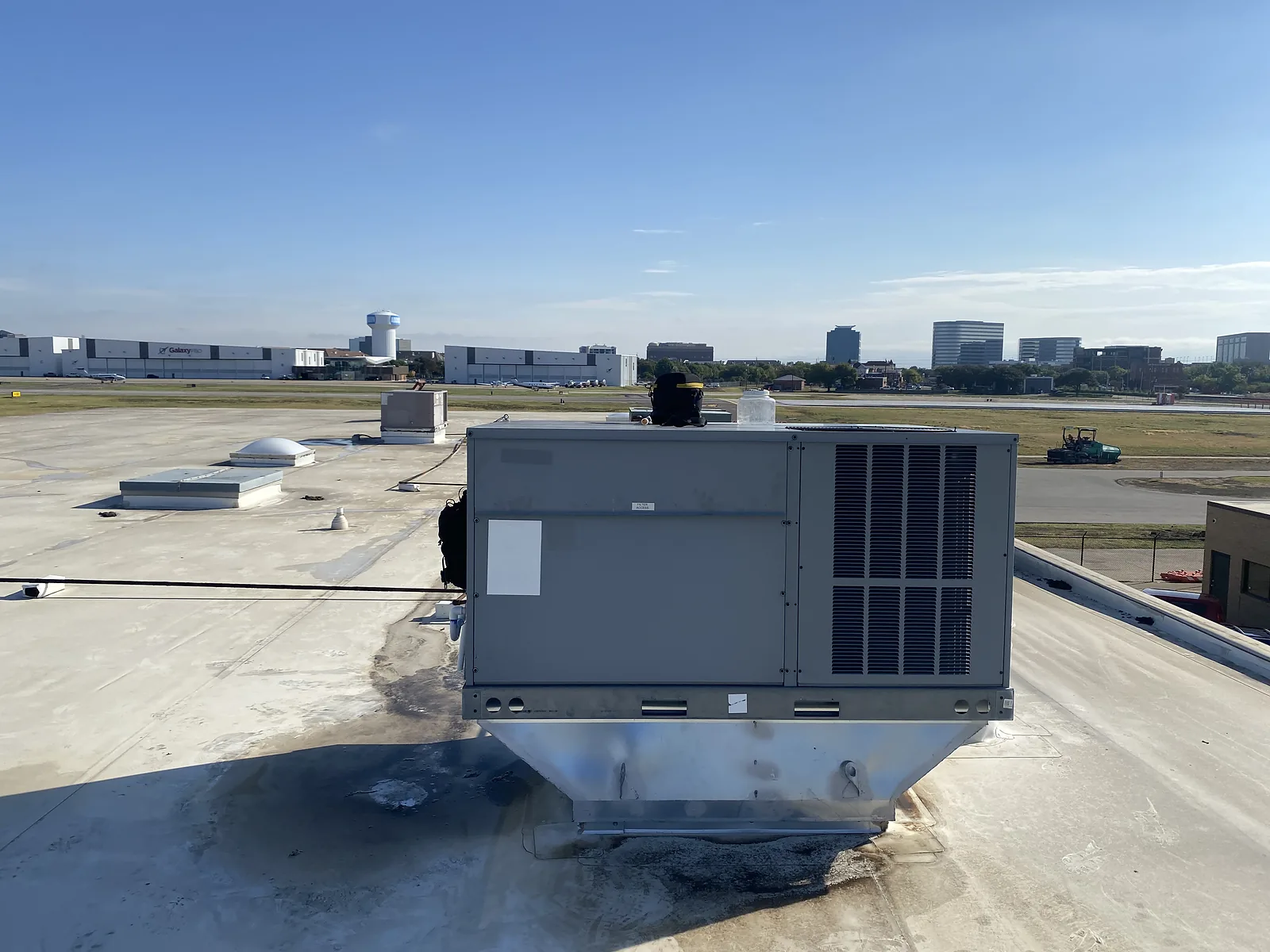
Rooftop service includes filter and belt condition, blower wheel cleanliness, condenser coil condition, economizer and outside-air damper operation, condensate drainage and pan condition, curb and cabinet integrity, safety controls, and the gas heat section on units that heat. We measure before and after so you can see what changed.
Split-System Service for Commercial Spaces
Offices, salons, medical suites, small retail bays and converted spaces are frequently served by split systems or ductless mini-splits rather than rooftops. These systems fail in different ways: long line sets with the wrong charge, indoor units mounted where return air short-cycles, condensate pumps that clog, and outdoor units crowded against a wall or a fence with no room to reject heat.
We service commercial split systems and mini-splits with the same diagnostic sequence used on rooftops, and we look specifically at whether the installation itself is limiting performance — line-set length and charge, clearance around the condenser, and whether the indoor unit is actually able to see room air.
Compressor and Component Replacement
When a compressor, condenser fan motor, blower motor, contactor, capacitor, control board, gas valve, ignition control or metering device has genuinely failed, we verify the failure electrically and mechanically before quoting the part. A compressor that will not start may have a failed run capacitor, a burnt contactor, a locked rotor, or a low-voltage control problem — those are four different repairs at four different prices.
We also check what caused the failure. A compressor that fails from high head pressure caused by a filthy condenser coil will fail again if only the compressor is replaced. Correcting the cause is part of the repair, not an upsell.
Airflow and Static-Pressure Testing
Airflow is where most commercial comfort complaints actually live. Undersized returns, closed-off ceiling plenums, tenant build-outs that added walls without adding ductwork, and filter banks upgraded to a higher MERV than the blower can handle all raise static pressure and reduce delivered capacity.
We measure total external static pressure, supply and return static, and airflow across the coil, then compare those numbers to what the equipment is rated to move. That comparison tells you whether a space is uncomfortable because the equipment is failing or because the air cannot get where it needs to go — and it frequently prevents an unnecessary equipment replacement.
Preventive Maintenance for Light-Commercial Properties
Commercial equipment runs far more hours than residential equipment and is almost always out of sight, so it degrades quietly. Scheduled maintenance is the difference between a filter change and a compressor.
A maintenance visit covers filters, belts, blower wheel and coil condition, condensate drainage, electrical connections and component testing, refrigerant charge verification, economizer and damper operation, control and staging checks, and readings taken on each unit. Visit frequency depends on the building — a restaurant with heavy grease-laden air and constant door traffic needs attention far more often than a quiet office suite.
- Filter, belt, blower wheel and coil condition on every unit
- Condensate pan, drain and pump verification before a ceiling leak happens
- Electrical tightening and component testing under load
- Refrigerant charge verified by superheat and subcooling
- Economizer, damper and outside-air operation checked, not assumed
- Findings explained for each unit before work is approved
Thermostat and Control Diagnostics
A large share of commercial no-cool and no-heat calls are control problems: a thermostat programmed against the building's actual schedule, a staging setup that never brings on second stage, an economizer stuck open on a 100-degree afternoon, a failed transformer or a nuisance-tripping safety circuit, or a tenant-accessible thermostat being fought over all day.
We verify the control sequence against the equipment, confirm each stage actually energizes, check low-voltage integrity and safeties, and make sure the schedule matches when the building is occupied. Locking controls, correcting staging, or fixing a wiring fault often solves a complaint that looked like failing equipment.
Commercial Heating and Cooling Repair
On the heating side, light-commercial equipment usually heats with a gas section in a rooftop unit, a gas furnace paired with a split system, or heat-pump operation with electric auxiliary heat. Common failures are ignition controls and igniters, flame sensors, gas valves, pressure switches, inducer motors, limit trips caused by low airflow, and heat exchanger deterioration.
Combustion equipment gets a safety check as part of the repair: combustion readings, venting and flue condition, and carbon monoxide testing. If a heat exchanger has failed, we say so plainly and explain the options rather than patching around a safety issue.
On the cooling side, repairs range from capacitors, contactors and fan motors to refrigerant leak location and repair, coil replacement and compressor replacement. Leaks are located and repaired rather than topped off, because adding refrigerant to a leaking circuit is money spent twice.
Replacement Evaluation
Replacing commercial equipment is a capital decision, so it deserves numbers rather than a sales pitch. A replacement evaluation looks at measured performance, the equipment's age and condition, parts and refrigerant availability, the cost of the repair in front of you compared with recent repair history, the condition of the curb, ductwork and electrical service, and whether the current capacity actually matches how the space is being used today.
Tenant build-outs change loads. A space designed as open retail and later divided into offices, or a kitchen that added equipment, may need a different capacity or different air distribution — not simply a like-for-like swap. Too Cool Air explains the measurements, findings and recommended options before work is approved, so an owner or property manager can make the decision on facts.
Clear Findings Before Work Is Approved
Commercial decisions rarely sit with one person. A tenant calls the property manager, the property manager calls the owner, and everyone needs the same answer: what is wrong, what it costs, and what happens if it waits. Too Cool Air explains the measurements, findings and recommended options before work is approved, so the person approving the repair can see what the readings showed rather than taking a diagnosis on faith.
Priorities are separated plainly: what is a safety or downtime risk, what should be planned soon, and what can wait for the next budget cycle. That makes budgeting and tenant communication simpler without promising anything the readings do not support.
Temperature Split and Humidity Testing
Temperature split — the difference between return air and supply air — is one of the fastest honest indicators of whether a unit is doing the work it is rated for. Read alongside airflow and static pressure, a low split points toward a charge or compressor problem, while a high split usually means the unit is starved for air. Read alone, it means very little, which is why we take all three.
Humidity gets ignored on commercial jobs more often than any other measurement, and in North Texas it drives most of the complaints that get described as "it feels muggy in here." We measure relative humidity in the space along with entering and leaving conditions at the coil, because an oversized unit that satisfies the thermostat in short bursts never runs long enough to remove moisture. Door traffic in a retail bay, dish and kitchen loads in a restaurant, and outside air brought in through an economizer or makeup-air unit all add moisture the equipment has to handle.
When a space holds temperature but still feels uncomfortable, the fix is usually run time, airflow or outside-air control rather than a bigger unit. Measuring tells us which, and it keeps you from buying capacity that makes the humidity worse.
Commercial Comfort and Operating-Cost Considerations
Commercial comfort problems are rarely uniform across a building. A space with a west-facing glass storefront, a back office with one undersized supply register, and a kitchen fighting its own exhaust are three different loads on equipment that was often zoned as if they were one. Measuring airflow room by room shows where the air is actually going and what a balancing or duct correction would be worth.
Operating cost follows the same measurements. High static pressure makes the blower consume more energy to move less air. A dirty condenser coil raises head pressure and compressor amp draw. A stuck economizer damper can pull in hot, humid outside air while the compressor runs against it. Thermostats left without schedules or lockouts run equipment through hours the building is empty. None of these show up on a nameplate — they show up in readings, and every one of them is cheaper to correct than to keep paying for.
The point of measuring all of it is a straightforward operating decision: which corrections pay back quickly, which are comfort improvements worth their price, and which equipment is close enough to end of life that money should go toward replacement instead.
For Property Managers and Business Owners
If you manage a property or several tenant spaces, what you usually need is not another invoice — it is a clear per-unit picture: what equipment is on the roof, its age and condition, what was found, what was done, and what is likely next. Too Cool Air explains the measurements, findings and recommended options before work is approved, so you can separate a safety or downtime risk from something that can wait for the next budget cycle.
For business owners, the practical concerns are downtime, disruption during open hours, and predictable cost. Service is by appointment, so tell us your operating hours when you book and we will schedule diagnostics and maintenance around them where the calendar allows. Repair pricing is given after diagnosis and before work starts, and tenant or landlord responsibility questions are easier to settle when the readings and findings are explained clearly before work starts.
For questions about a multi-unit property, an upcoming build-out, or a lease-required maintenance schedule, call (214) 437-7886 with the addresses and equipment list and we will tell you plainly what we can take on.
Properties We Serve
Too Cool Air serves light-commercial facilities: offices and office suites, retail storefronts and strip-center bays, restaurants and coffee shops, convenience stores, salons and studios, small medical and dental offices, churches, and similar buildings served by rooftop package units, split systems or mini-splits.
Large industrial plants, central chiller plants, built-up air-handling systems and process cooling are outside what we take on. If your building needs that scope, we will tell you rather than learn it on your roof.
Scheduling and Availability
All commercial service is by appointment. Availability varies by season — the weeks after the first serious heat and the first hard freeze are the busiest — so calling (214) 437-7886 to confirm timing is always faster than assuming a window. Because the business is owner-operated, we would rather give you an honest schedule than promise coverage we cannot staff.
For properties that cannot tolerate downtime during business hours, we schedule diagnostics and planned maintenance around your operating hours where the calendar allows. Tell us your hours when you book and we will work to them.
What Our Clients Say
Our reviews live on our public Google Business Profile, where every rating comes from a verified customer.
Read Our Verified Google ReviewsHVAC Service FAQs
Get answers about our HVAC services in Grapevine & DFW
Related Services You Might Need
Technical Sources
- ASHRAE — Standards 62.1 and 62.2 — Ventilation and Acceptable Indoor Air Quality
- Air Conditioning Contractors of America (ACCA) — Residential Technical Toolbox (Manual J, D and S guidance)
- Texas Department of Licensing and Regulation — Air Conditioning and Refrigeration Contractors program
These references provide general industry, regulatory and public-health guidance. Their inclusion does not imply endorsement of Too Cool Air.
Too Cool Air is based in Grapevine, TX. See HVAC services in Grapevine or browse the full service areas.
Schedule Commercial HVAC Service
Call (214) 437-7886 or book online and we will confirm the next available service window for your property.
Schedule your service today. 28+ years of honest, diagnostic-first HVAC service.